

Are We Post-Constitutional Yet?

Should we be?
This isn’t wishful thinking or abstract theory. It’s a genuine question (and my conclusion) drawn from thirty years advising governments worldwide on constitutional design and democracy, surviving a rocket attack while helping revise Iraq’s constitution in 2009, and witnessing the systematic failure of constitutional frameworks, from war zones to Western democracies. The question is no longer whether constitutions can provide checks and balances, or embed the rule of law and protect individual and group rights. They manifestly cannot in our current moment. The question is: what democratic alternatives are already filling the void, and how do we nurture them?
Constitutions promised stability through hierarchical authority structures and guaranteed, actionable rights. Constitutional courts and supreme courts were the chosen guardians of these sacrosanct documents of ‘higher law.’ But constitutions were designed for a world that no longer exists. They assumed bounded nation-states with sovereign control, but power now flows through transnational networks and corporations and even individuals that dwarf most governments. We have twenty-something entrepreneurs (like Mr Beast) building influential and direct platforms and we have no idea whether to constrain, or enable, them. Or how. Constitutions assumed relatively homogeneous populations with shared values, but we increasingly live with and encourage deep pluralism, where no single constitutional settlement can adequately and equally respect diverse communities. They assumed slow, or at least predictable, change, and the best of them rested on deliberative processes. But crises now cascade faster than constitutional mechanisms can respond: pandemic, climate, financial, territorial. And crucially, constitutions functioned well under information scarcity where representative institutions and expert interpreters were buffers. We now instead have information abundance and direct communication that renders our constitutional mediating institutions obsolete or, worse, obstacles.
Constitutionalism as theory is now nostalgic and constitution as technology is simply obsolete.
It’s not that we’re implementing constitutions badly or that bad actors are subverting them. Indeed both happened from the beginning. It’s simply that the operating system doesn’t match the hardware anymore. We can’t adapt these frameworks fast enough to match the pace of change, so the gap between constitutional theory and lived reality grows wider each year, haemorrhaging legitimacy. To take the oldest living constitution, the US, as an example: more than half of Americans now distrust the Supreme Court, the guardian of our Constitution.
What makes this moment fascinating rather than terrifying?
We can prepare the next generation for horizontal, self-organizing democracy rather than hierarchical, constitution-dependent governance, starting age three. Because the answer begins in early childhood education. In Reggio Emilia, Italy—the same Italian region that my former colleague Bob Putnam found had the strongest democratic culture in his landmark study—I’ve observed preschools that organise little lives around what they call “the piazza”: a large, open common space at the heart of each school where children aged three to six spontaneously congregate, negotiate, and bump up against one another. When my son attended one of these schools, I watched a boy in high heels and a feather boa greet me at the door. Not as transgression but as creative self-expression in a space designed for emergence rather than control. The contrast with traditional preschools is stark: where most schools divide space by activity and age and direct children’s movement, Reggio Emilia’s state pre-schools create conditions for common knowledge—for children to see that others see that they all share this space and must cooperate to use it. And from Montessori’s self-organizing classrooms to Denmark’s adventure playgrounds, where children use loose parts (broken planks, cardboard, discarded materials) to build their own structures, research shows that children develop exactly the capacities post-constitutional democracy requires: risk assessment, collective problem-solving, resilience, and the ability to intervene constructively in community conflicts. Unfortunately, these approaches are still considered alternatives for crunchy parents, but they need to be mainstream if we are to accept the challenge of this post-constitutional moment.
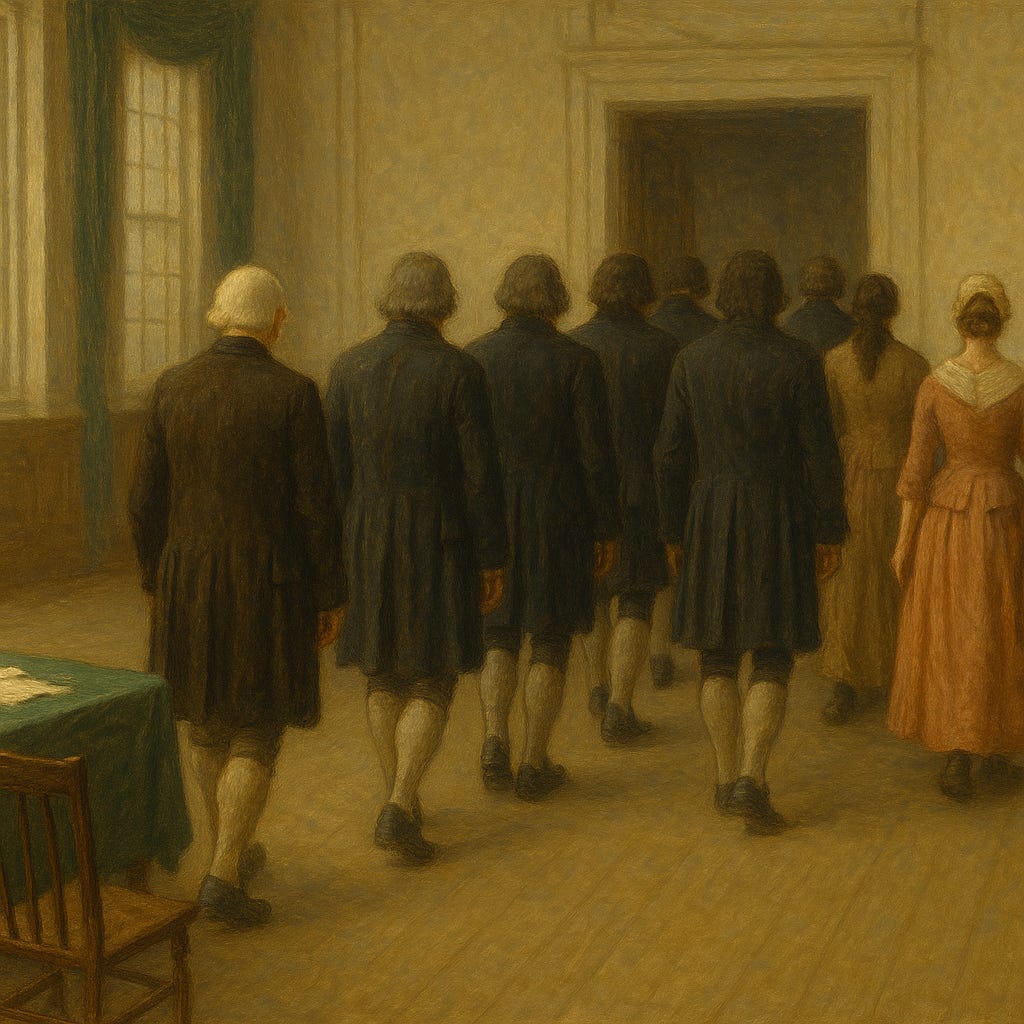
AI generated image of constitutional ‘founders’ leaving the room instead of signing the document, inspired by classic paintings of the Constitutional Convention.
A second, concrete intervention then extends these ideas of the piazza, outside of the preschool, to the public space for everyone, where they began. Constitutions imagine democracy happening in designated institutions: parliaments, courts, voting booths. Post-constitutional democracy happens in the piazzas: the physical and digital commons where citizens encounter difference and practice cooperation. During the pandemic, when constitutional governments ordered public spaces closed, citizens created new ones: community gardens, skateparks, mutual aid networks. I’ve documented many of these: Liverpool’s Granby Four Streets project transformed a derelict neighbourhood through collective action when formal authorities withdrew; youth in multiple cities built skateparks themselves when municipalities didn’t get it together. What makes these spaces post-constitutional is that they don’t wait for permission or governmental provision or a written document. No rulebook. They emerge through what I call in my recent book “guerrilla constitutionalism.”
At this stage in our post-constitutional development, emergence alone isn’t enough; we still need intentional design to encourage it, without it being dictated. In a recent piece in Nature: Cities, I offer some ideas for building these piazzas. Plenty of ideas are being offered around the world. Some women in North London had their own idea. Inspired by senior co-housing in the Netherlands, they decided to create something special. In this suburb north of London, you’ll find a group of 26 women, aged between 50 and 80, who came together to design, inhabit and co-manage their own housing community: Older Womens Co-Housing (OWCH). You enter this housing complex through a shared house, a common space for gathering and meals, their version of the Reggio piazza. The architecture was deliberately designed to encourage communication and interaction, both between residents, and with the greater North London community outside, while respecting residents’ privacy. All the women here have entered the space from different walks of life and for different reasons, and bring that diversity to enrich the place they inhabit. I have not yet visited this space, but am eager to understand it better and see how it works. Their shared ‘constitutional’ values, as declared on their website, include:
“Acceptance and respect for diversity
Care and support for each other
Providing a balance between privacy and community
Countering ageist stereotypes
Co-operating and sharing responsibility
Maintaining a structure without hierarchy
Caring for the environment
Being part of the wider community”
I’m glad we still have a basic framework of rights and order, but let’s make it the understudy in our dramas, not the main actor. The post-constitutional world is here. The only question is whether we’ll stumble into it blindly, or shape it intentionally, as some are already doing. Maybe democracy doesn’t need to be saved from constitutional collapse. Maybe instead, it needs to be responsibly and democratically liberated by it.
What do you think?